


A lot of Milwaukee homeowners have heard some version of "the insurance company will buy you a new roof." Sometimes that turns out to be true. Often it does not, and the difference usually comes down to two questions: what caused the damage, and what your policy actually says.
Here is a plain-language look at what claims tend to include, where they usually stop, and how to keep yours organized. It is general information, not insurance or legal advice. Your policy and your agent are the final word.
Where claims usually land
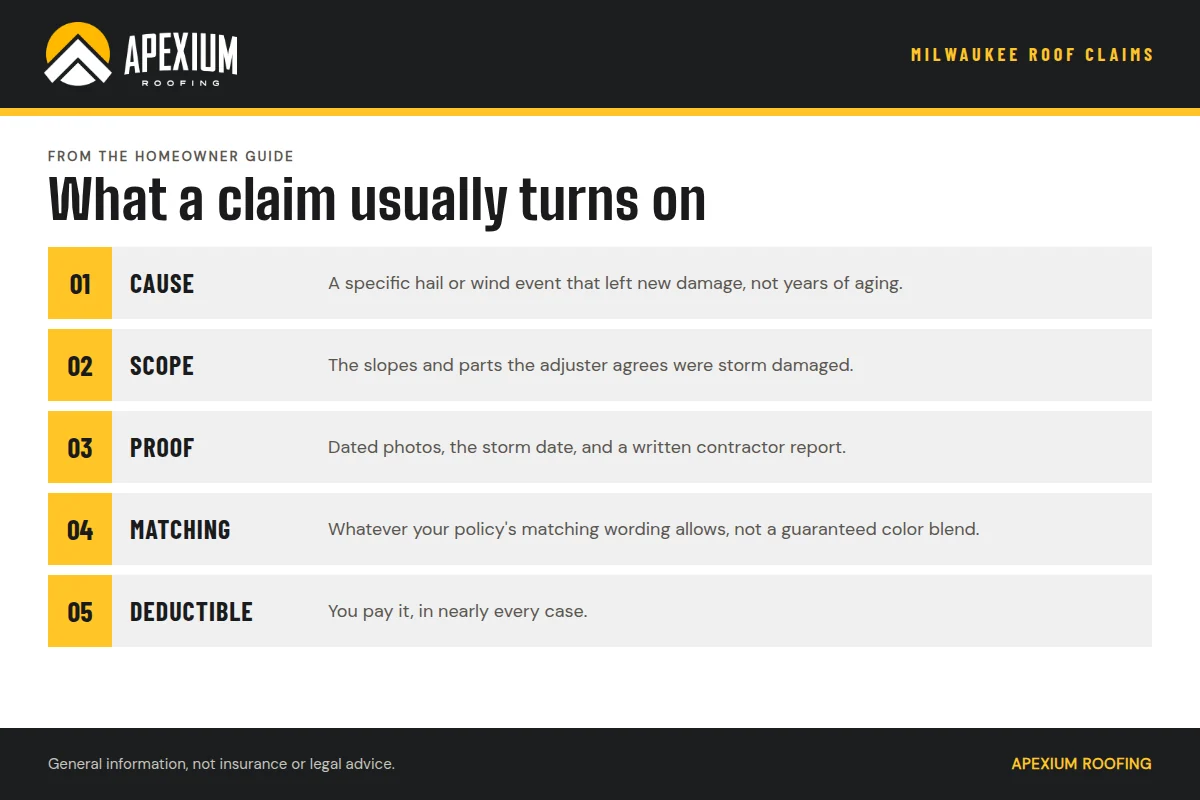
| Question | Usually helps a claim | Usually works against it |
|---|---|---|
| What caused it? | A specific hail or wind event that left new damage | Years of aging, skipped maintenance, slow leaks |
| What is included? | The slopes and parts the adjuster agrees were storm damaged | Upgrades or style changes with no damage behind them |
| What proves it? | Dated photos, the storm date, a written contractor report | "It just looks old" with nothing to show |
| Will it match? | Whatever your policy's matching wording allows | Expecting an exact color blend no matter what |
| Who pays the deductible? | You, in nearly every case | Hoping it quietly disappears |
Your declarations page and policy forms spell out what you have. If the language is confusing, ask your agent to walk through it with you.
Ice dams are their own story
Milwaukee roofs see two very different kinds of winter and storm problems. Hail and wind damage come from a single event you can usually date. Ice dams build over days of freezing and thawing and push water up under shingles. Insurers often look at these differently, and some ice dam leaks are tied to attic ventilation or insulation rather than to a storm. Ask your agent how your policy handles each one before you assume they will be treated the same way.
How a claim usually moves
- Make the house safe. Contain any active leak if you can do it without climbing on the roof.
- Take photos of every side of the house and any damage you can see from the ground, before temporary fixes cover things up.
- Call your insurer and open a claim if you believe a storm caused the damage.
- Have a roofer inspect and give you a written report that says what was found and whether they recommend repair or replacement.
- When the adjuster's estimate arrives, compare it to the roofer's report item by item.
- Ask your questions before anyone starts tearing off shingles.
Our guide on filing a roof insurance claim in Wisconsin goes deeper on the paperwork side.
Matching and discontinued shingles
People often expect a repair to blend in perfectly. Whether your policy pays for a broader repair to get a match depends on its wording, and that varies. When the original shingle is no longer made, the scope sometimes grows beyond the damaged area. A roofer can document what is on your roof. Only your policy decides what it pays for.
Surprises during tear-off
Soft decking or failed underlayment is sometimes hidden until the old shingles come off. A good written scope explains what happens if more damage turns up, and your roofer should photograph anything new. Insurers handle these additions through a supplement, so ask your contractor how they document and submit them.
Your deductible and your share
Plan on paying your deductible. Any upgrade beyond what the storm damaged, such as a different shingle line or new gutters that were not hit, is usually on you too. Ask for a clear breakdown of what the insurer is expected to pay based on the current estimate and what you will owe. Treat the first numbers as a starting point, since supplements can change them.
Watch for storm chasers
After a big hail day, door knockers show up fast. Be cautious about blank contracts, pressure to sign the same day, and crews with out-of-state plates and no local address. Ask who pulls the permit with the city, who stands behind the workmanship, and how to reach them next spring when the snow melts.
What to keep in your file

- The storm date and any weather alerts you saved
- Dated photos of the outside, the attic, and dented metal like vents and gutters
- Your roofer's written report and recommendation
- The adjuster's estimate and any supplements
- Notes from your agent on your deductible and matching coverage
Hold onto all of it until the work is finished and your warranty paperwork is in hand.
After the claim is approved
Ask about material lead times, how the crew will protect the house if a cold snap or rain shows up mid-job, and whether cleanup and magnet sweeps for nails are included. Get the schedule in writing so an approved claim turns into a finished roof without guesswork.
Need a second set of eyes?
Apexium offers roof insurance claim help in Milwaukee, starting with a documented inspection. If you are not sure whether the last storm did any damage, our post on hail damage roof inspections in Milwaukee explains what we look for. For everything else, reach out to Apexium, your roofing contractor in Milwaukee.
FAQ
Will insurance replace my whole roof after hail?
Not automatically. What gets paid depends on the damage that was documented and on your policy terms.
Should I hire a public adjuster?
Sometimes it helps, often it is not needed. First ask your agent and your roofer whether anything is missing from your documentation.
Can a roofer promise my claim will be approved?
No. An honest roofer can document the roof thoroughly. The decision belongs to the insurer.
Are ice dam leaks covered?
It depends on your policy and on what caused the leak. Ask your agent before assuming it is handled like hail.
Have a specific question about your Milwaukee roof? We answer directly.